
Can a trustee sell a house in Tennessee? A trustee may have authority to sell, but the answer comes from the trust, the current appointment, applicable law and any court orders—not simply from having the house keys. Before accepting an offer, verify who owns the property, who can sign and what approvals or notices the particular sale needs.
I’m Jason with Diamond Home Buyers. If you’re comparing a sale of a trust-owned house, I want you to have the paperwork and the options in front of you. A cash offer cannot fix missing authority or replace advice from your own attorney or tax adviser. This guide is a preparation checklist, not a legal opinion about your trust.

Start with these three checks
- Match the recorded deed to the trust and the current trustee’s authority.
- Compare the sale options and likely net proceeds using documented property information.
- Resolve legal, title and tax questions before committing to a price or closing date.
On this page
- Who Can Sell Trust Property Under Tennessee Law
- Revocable vs. Irrevocable Trusts: What Changes for a Sale
- Step-by-Step: Completing a Trust Property Sale in Tennessee
- Deed Wording, Title Requirements, and Closing Logistics
- Tax Consequences Trustees Should Understand Before Closing
- Fiduciary Risk and Recordkeeping That Protects Trustees
- How a Local Cash Buyer Handles Trust-Owned Properties
- A Practitioner’s Take on Choosing Your Path
- Get a Cash Offer for a Trust-Owned Tennessee House
- FAQ
- Sources
Who can sell trust property under Tennessee law?
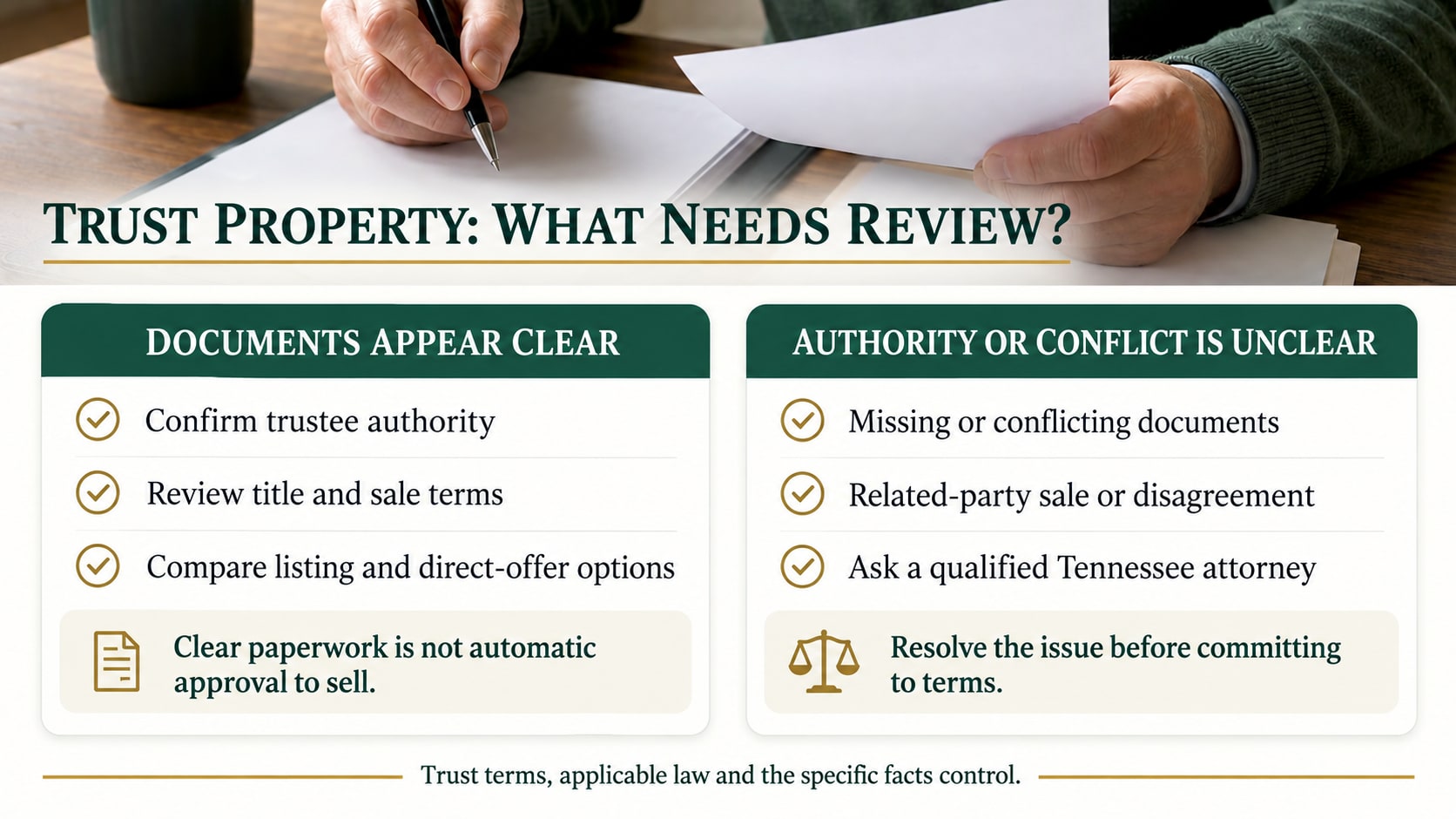
Start with the complete trust and its amendments. Check the acting trustee, successor appointment, co-trustees, powers to sell, and any notice, consent or direction requirements. Being a beneficiary is not the same as being authorized to sign for the trust. A death or resignation may require additional documents establishing who now acts.
Tennessee Code §35-15-816 includes a default power to acquire or sell property. That provision must be read with the trust and other applicable rules. The source draft’s claim that no statute can override the trust is too broad: Tennessee Code § 35-15-105 expressly identifies mandatory rules. Ask Tennessee trust counsel how the instrument and those rules apply before relying on a general power of sale.
A certification of trust can help document authority without assuming that every private provision must be shared with every potential buyer. Section 35-15-1013 addresses certification; the closing professional may need supporting information about the particular transaction. The API supplied Tennessee Bar Association guidance on title to trust property as an additional reference. Do not send unredacted identification, account numbers or the entire estate file through a public contact form.
Tennessee Code § 35-15-114 permits real property to be acquired in the trust’s name or in the trustee’s name for the trust, and calls for a conveyance by the trustee in that capacity. Match the actual deed rather than guessing from an assessor’s abbreviated name. Family ownership questions can also arise outside a trust; selling an inherited house with siblings in Tennessee addresses that separate situation.
Revocable or irrevocable: what actually changes?
Those labels are useful starting points, not a complete signing checklist. A revocable trust may give a living settlor significant control, but that does not make every beneficiary an owner who can sign a sale contract. An irrevocable trust is not automatically unable to sell. Read its powers and limits, identify the acting fiduciary and obtain advice when authority is unclear.
After a death, check successor provisions, any required proof of death, allocation or distribution directions, and whether another fiduciary must participate. Do not assume that every asset mentioned in a trust was properly transferred to it. If the recorded ownership is still in an individual’s name, an attorney and title professional need to identify the correct path.
Keep the property-sale question separate from the rest of the estate administration. A trust-owned house and other probate assets can involve different authority, records and timelines. A trust label alone does not establish that probate is unnecessary, that beneficiary consent is always required, or that court involvement can always be avoided.
Eight steps before and during a Tennessee trust sale
- Gather the governing documents. Locate the trust, amendments, deed and relevant appointment records. Have counsel identify the operative versions. Make a list of missing documents rather than filling gaps with family recollections.
- Identify the required decision-makers and signers. Check co-trustees, consent provisions, directions and court orders. Get the signing requirements established before a buyer expects a binding agreement.
- Open a title review. A title search and commitment can surface mortgages, liens, recorded restrictions and ownership questions. Request dated payoff information through the proper channels. A cash purchase does not make those matters disappear.
- Document the property and value. Gather condition reports, repair estimates and available valuations. Discuss an independent appraisal or appropriate broker analysis with the advisers handling the sale. An assessor’s figure, online estimate and buyer’s offer answer different questions.
- Compare realistic sale routes. Consider a traditional listing, an as-is listing and a direct offer. Put expected proceeds, preparation costs, carrying costs, inspections, contingencies and timing side by side. The highest headline price is not necessarily the highest net result, but convenience alone does not establish that a deal serves the trust.
- Determine the applicable disclosure requirements. Tennessee’s disclosure rules include exceptions, including certain fiduciary transfers. Have counsel determine whether an exception applies and what other duties remain. “As-is” is not permission to make false statements or conceal known problems. The source supplied Tennessee Residential Property Condition Disclosure Act as a historical legislative reference; that older enactment is not a substitute for checking current law.
- Review and execute the actual contract and deed. Have the proper professional prepare or review capacity, legal description, signatures and acknowledgment. Verify the named buyer, any assignment rights, deposits and termination conditions. Do not copy a signature block from a general article and assume it fits your trust.
- Close, account and make authorized distributions. Review the settlement statement, required releases and recording. Keep the sale proceeds in the appropriate trust account. Resolve reserves, expenses, taxes, claims and distribution instructions with the responsible advisers before paying beneficiaries.
Source-link clarification: the API’s link labeled Tennessee disclosure obligations points to a Florida law firm’s discussion. Its original anchor and destination are preserved, but it is not authority for Tennessee law. For Tennessee, review the current Residential Property Disclosure Act, including § 66-5-209, with qualified counsel.
If other assets need probate administration, the probate sale guide for Tennessee can help you organize that separate file. It does not convert trust administration into a probate proceeding or give a trustee authority that the documents do not provide.
Deeds, title and closing logistics
The important point is the capacity in which the authorized person acts. The documents should accurately identify the parties and the trust interest being conveyed. The trust name, dates, appointment documents and recorded title need to be reconciled by the people preparing and insuring the transfer. An omitted detail is not something a buyer’s marketing promise can cure.
Ask the closing professional for a written document list and a secure delivery method. That may include a certification, relevant trust provisions, amendments, proof of succession and identity verification. Requirements depend on the actual file; there is no universal packet that guarantees closing.
The source’s realty transfer recordation tax guidance is a March 2023 manual. Tennessee Revenue also provides guidance on certain revocable-living-trust transfers. A qualifying transfer into or out of a trust is not the same transaction as an ordinary sale to an unrelated buyer. Ask the closer to determine the applicable transfer tax, exemptions and recording charges for the deed actually being recorded.
Before signing, separate the sales price from loan payoffs, liens, taxes, professional fees, agreed closing costs and reserves. Read the proposed disbursements. Independently confirm wiring instructions using an established telephone number, not a new number in a last-minute email.
Tax questions to settle before accepting an offer
Do not use “revocable” and “irrevocable” as automatic answers to who reports the sale. Grantor-trust tax treatment, ownership, distributions and the circumstances at the time of sale matter. The Instructions for Form 1041 explain reporting for estates and trusts, including special grantor-trust reporting. A qualified tax adviser should identify the correct taxpayer and applicable forms for your file.
Inherited-property basis is generally tied to date-of-death value or another permitted valuation method, subject to exceptions. That can be an adjustment down as well as up. Not every asset held in a trust automatically receives a new basis when someone dies. Check the ownership and estate-inclusion facts, prior basis, valuations and improvements. The IRS inherited-property basis explanation is a useful starting point, not a calculation of your tax bill.
Depending on the taxpayer and transaction, the adviser may consider Form 1041, a relevant Schedule D, Form 8949 or other reporting. Form 8971 has specific estate basis-reporting rules; it is not required for every trust-owned house sale. Selling soon after a death does not guarantee that no gain, income tax or filing obligation exists.
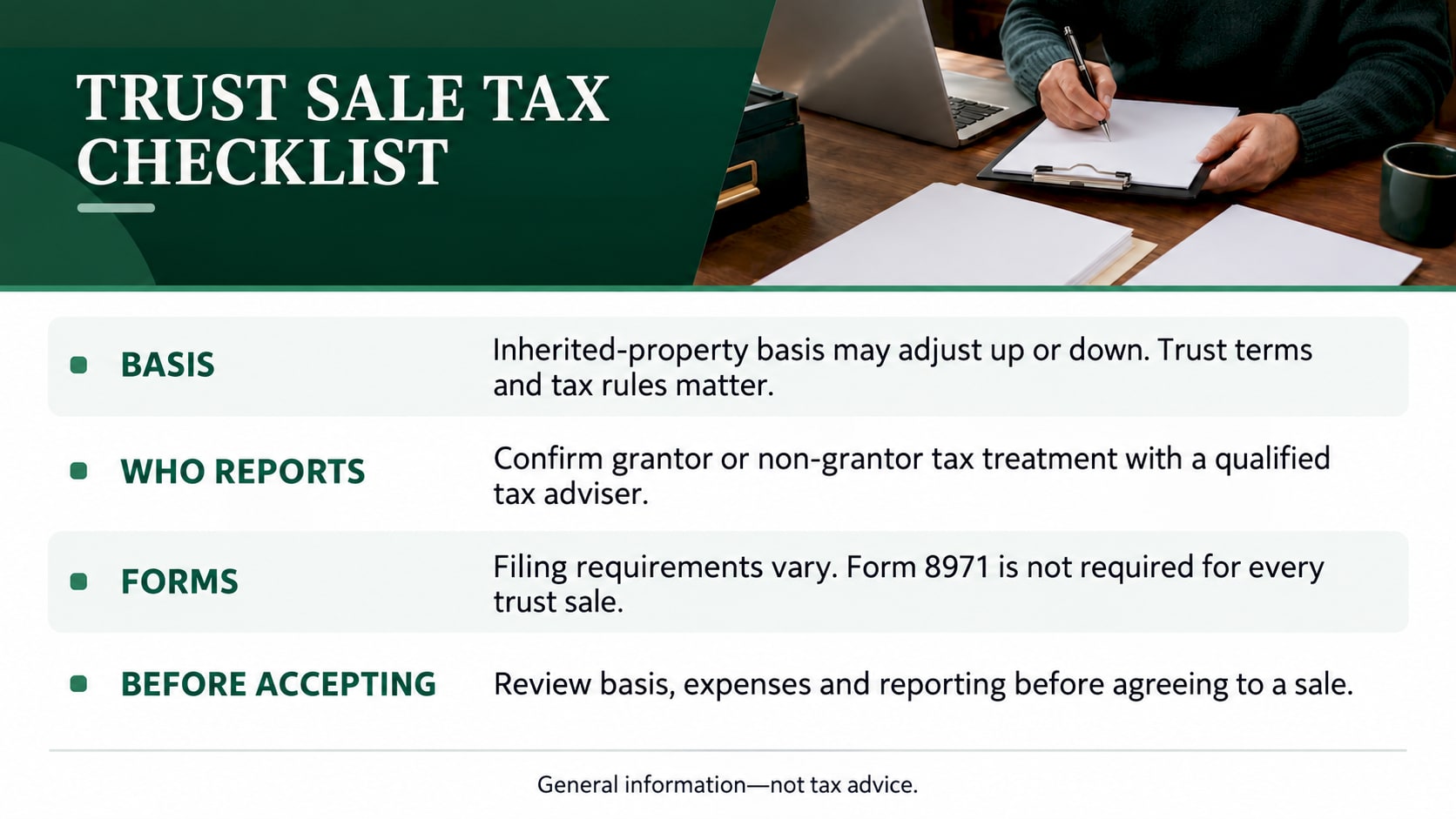
Keep the acquisition and valuation records, invoices for documented improvements, selling expenses and final closing statement. Ask about reporting and needed reserves before distributing the proceeds. A general home-buying article cannot decide what a beneficiary or trust should put on a return.
Fiduciary duties and a useful decision file
A trustee is making a decision for the trust, not simply choosing the easiest personal outcome. An organized record should explain what information was available, which options were considered and why the chosen terms fit the trust’s purposes and beneficiaries’ interests. Documentation helps explain a decision; it does not automatically eliminate liability.
Keep dated valuations, property reports, marketing records, written offers, adviser recommendations, required notices and the final settlement statement. If an offer changes, keep both versions and the reason. Record repair assumptions and access limits so a later reader can understand the comparison.
Ask counsel before committing to a related-party sale, proceeding over an unresolved objection or relying on ambiguous authority. Whether consent, a court process or another safeguard is appropriate depends on the documents and law. A beneficiary’s silence is not a universal approval rule.
The provider included this Tennessee Court of Appeals opinion. We retained the link, but do not rely on the draft’s unverified summary of that case as a finding about your transaction. Have counsel review the actual opinion and its procedural posture if it is relevant.
Comparing a cash offer for a trust-owned house
At Diamond Home Buyers, I or our underwriting team review properties we consider. Start with the address, known condition and your role in the proposed sale. Authority and title still need to be verified through the proper professionals. A conversation or offer request is not permission to sell trust property.
A direct as-is offer can be useful to compare when the house needs work or when managing preparation and showings would be difficult. An open-market listing may produce a better result in another situation. Compare the written terms and expected net proceeds instead of assuming either route always wins.
Ask who will buy, how funds will be verified, what inspections remain, whether the contract can be assigned and which conditions allow cancellation or a price change. We may buy directly, work with partners or use an assignment, depending on the transaction. The written agreement should identify the actual arrangement. Standard closing costs we agree to cover are distinct from the trust’s debts, taxes and professional-adviser expenses.
A seller-focused way to choose the next step
My practical suggestion is to separate “the house can be marketed” from “this person has authority to commit the trust.” Start with the authority file, then the property and offer comparison. Clear-looking paperwork and a cooperative family do not by themselves establish legal approval.
If authority, title or a conflict is unresolved, get the right adviser involved before a signature creates new obligations. If those questions are resolved, compare the available listing and direct-sale terms using the same property facts. Keep the legal decision with your counsel and the transaction decision with the properly authorized fiduciary.
Request a trust-property offer review
If you want another option alongside a listing, you can request a no-obligation cash offer. Tell us the property’s location, condition and the authority questions you are working through. You do not need to promise a closing date just to start that conversation.
We consider residential property, land, multifamily buildings, townhomes and mobile homes individually. Property fit, title, access and the agreed terms still matter. No offer, acceptance or closing timeline is guaranteed. Your own attorney and tax adviser remain responsible for advising you on the trust’s legal and tax obligations.
General information only, not legal, tax or investment advice. Have qualified Tennessee counsel and a tax professional review your documents and circumstances.
Trust-property sale questions
How hard is it to sell a house that’s in a trust?
The work depends on trustee authority, the recorded title, the trust’s terms and the proposed sale. Confirm the required documents and signers before accepting an offer. A trust label alone does not establish that court approval is required or unnecessary.
What are the tax implications of selling a house in a trust?
Basis, grantor-trust tax treatment, distributions and the facts at the time of sale affect reporting. Revocable or irrevocable status alone is not a complete answer. Ask a qualified tax adviser to identify the taxpayer, applicable forms and needed reserves before closing.
What is the 5 year rule on trusts?
Do not treat that phrase as a general five-year waiting period or permission to sell a trust-owned house. Ask the adviser who raised it to identify the particular benefit, tax or account rule and explain whether it applies to this property and transaction.
How can I avoid capital gains on trust property?
There is no universal tax-free sale rule. Inherited-property basis adjustments have requirements and exceptions, and a basis adjustment can be down as well as up. Obtain a transaction-specific calculation before assuming that a prompt sale eliminates taxable gain.
What documents does a title company need for a trust property sale?
Ask for the closing professional’s written requirements. They may include a certification of trust, relevant trust provisions or amendments, succession records, identity verification and title or payoff documents. The exact requirements depend on the trust, recorded ownership and transaction.
Sources and retained provider references
The original API links and attributes below are preserved. The “2024” wording is the provider’s label, not our verification of the opinion’s decision date. Older legislative and tax materials should be checked against current law; retaining a link is not an endorsement of every statement on its destination.
Related Tennessee ownership guides
- Selling an Inherited House With Siblings in Tennessee
- How to Sell a House in Probate in Tennessee (2026 Guide)
- Sell a House During Probate in Tennessee Without Upfront Costs — retained provider URL; where consolidated, follow its redirect to the maintained guide.