Separate public showings from negotiated property access, then compare the buyer pool, written terms, likely net, and disruption for each route.
Updated: November 10, 2026
Provider illustration of a homeowner greeting a visitor for scheduled access. The people are not identified clients, company staff, or parties to a verified Knoxville transaction.
You can reduce or avoid public showings when selling a Knoxville house, but each route handles access differently. A conventional listing usually depends on buyer access, while a private listing, limited-access listing, for-sale-by-owner plan, or direct sale may narrow the number of visits. Even a direct buyer may need agreed access for a property review. This guide explains the tradeoffs, Tennessee requirements, and a practical comparison for Knox County sellers.
Diamond Home Buyers
Explore a Sale Without Showings
Diamond Home Buyers considers as-is cash purchases in Knoxville and Knox County, with a property review before any written offer.
A conventional listing is designed to expose a home to buyers, and most buyers want some form of access. One industry data company uses the categorical phrase a listing with no showings cannot sell. Treat that as sales commentary, not a universal rule: remote and sight-unseen offers can occur. The practical point is that limiting access may narrow the buyer pool, and even off-market or pocket listings commonly use appointments.
That doesn’t mean your only choice is to open your door every weekend. It means the question changes. Instead of asking how to list without showings, ask which kind of buyer needs the fewest visits, and whether that path fits your goals.
People usually want to avoid showings for practical reasons:
The house is occupied by a tenant, a family member or someone who is ill.
The house is vacant, out of state, or mid-cleanout after a death in the family.
The condition makes a public walkthrough awkward or unsafe: fire or water damage, an unfinished renovation, a failing crawl space.
Your schedule is tight because of a job change, a move or a divorce.
You simply don’t want strangers in your home.
Each of these is a legitimate reason, and each points to a different solution.
Your options for selling with few or no showings
Option 1: Sell directly to a cash buyer
A direct sale can remove public marketing and open houses. You share the address, condition, occupancy, and timeline, and the buyer evaluates the property. Photos, public records, and a conversation may start the review, but the amount and timing of physical access depend on the property, the buyer, and the written agreement.
Diamond Home Buyers reviews property details, ownership, condition, and closing requirements before deciding whether to make an offer. The company considers houses, rentals, inherited property, mobile homes with land, and vacant land as-is. Not every property or situation qualifies. On a direct purchase, seller repairs and a listing-agent commission are not required.
Option 2: Off-market or pocket listing
A pocket listing is marketed privately through an agent’s network instead of on the MLS. HousingWire’s guide to pocket listings notes that privacy and convenience are common reasons sellers choose them, and that they can reduce disruption for occupied homes and the need to make the property show-ready. Showings still happen, just with fewer people. You also still work with an agent, and a smaller buyer pool can affect price and timing.
Option 3: List, but limit access
Some sellers keep the MLS route and restrict showings: appointment only, 24 hours’ notice, certain days. This keeps your price exposure wide but doesn’t remove the visits. It works best when the house is in good shape and you can tolerate some disruption.
Option 4: For sale by owner
Selling without an agent removes the commission but not the showings. You handle marketing, scheduling, negotiation and paperwork yourself. We cover that tradeoff in more depth in our guide on selling without a realtor in Knoxville.
Route
Showings
Repairs expected
Agent commission
Best fit
Direct cash sale
Fewer, controlled visits in many cases
No seller repairs required for a direct purchase
None for a direct purchase
Damaged, occupied, inherited or time-pressed properties
Pocket listing
Fewer, by appointment
Often some prep
Yes
Move-in-ready homes where privacy matters
MLS listing, limited access
Scheduled
Usually
Yes
Well-kept homes with flexible timing
For sale by owner
Yes, you run them
Usually
Not for a listing agent
Sellers with time and sales experience
How a no-showing cash sale works, step by step
The details vary by buyer and property, but a typical sequence looks like this. Redfin’s overview of cash offers describes the general pattern: proof of funds, a written offer with fewer contingencies, acceptance and signing, a title search and escrow, closing and deed recording.
Share the basics. Address, ownership, condition, whether it’s occupied, any mortgage, taxes or liens, and your ideal timeline. You can use our Tennessee cash offer calculator to start.
Property review. We look at public records, photos and what you tell us. If a visit is needed, we agree on one time that works for you or your tenant.
Written offer. The offer states the price, who pays which costs, access and the closing timeline. Price, access, costs and closing timing must be agreed in writing, and they depend on title and other transaction requirements.
Contract and title work. A title company or attorney searches the title, confirms who can sign, and prepares closing documents. General articles sometimes quote 7 to 14 days to close. That is not a Tennessee rule or a promise. The contract, title work, payoffs, required signers, access, and closing office determine the actual date.
Closing. You sign, the funds are disbursed, and the deed is recorded. In Knox County, deeds record with the Knox County Register of Deeds, and an attorney or title company typically handles this.
Notice what’s missing: staging, photographers, open houses, buyer walkthroughs and the wait for a buyer’s loan approval.
What Tennessee still requires when there are no showings
Skipping showings doesn’t skip the legal side of a sale. Four areas matter most.
Disclosure or an as-is disclaimer
For covered transfers, Tennessee law requires the owner to furnish either a disclosure statement listing known material defects or a disclaimer stating the buyer takes the property “as is”. Under Tenn. Code Ann. § 66-5-202, the disclaimer is permitted only where the purchaser waives the disclosure. A Tennessee condition disclosure summary adds that sellers must give the form before the buyer accepts a contract, aren’t required to get an inspection to fill it out, and aren’t required to repair listed items unless the contract says so. Whether a particular sale is covered is a question for a Tennessee real estate attorney. Our walkthrough, selling a Tennessee house as-is, explains how the disclosure and disclaimer work in practice.
Provider infographic retained unchanged as a simplified overview for covered Tennessee transfers. Exemptions and contract-specific disclosure duties can vary; obtain Tennessee legal advice for a specific sale.
Title, mortgage and liens
A mortgage balance, a tax lien or a contractor lien has to be paid from the proceeds or otherwise resolved at closing. A cash offer doesn’t erase those, and a buyer can’t ignore them. If you’re behind on payments or have back taxes, gather the payoff figures early. We’re a property buyer, not a lender, tax adviser or foreclosure-rescue service, so for tax or legal questions about your situation, speak with a Tennessee attorney or tax professional.
Who can sign
If you’re an heir, an estate representative, a trustee, a life-estate owner or a co-owner in a divorce, the buyer needs proof of your authority and sometimes other people’s consent. This is the most common reason a no-showing sale takes longer than expected. Gather letters of authority, trust documents or a divorce order before you accept an offer.
Closing mechanics in East Tennessee
Tennessee does not generally require an attorney to conduct a residential closing. A secondary guide says attorney closings are more common by local custom in East Tennessee, but that is a description of practice, not a legal requirement. A title company or attorney may handle the work; confirm the closing provider named for your transaction.
Comparing a cash offer with listing: look at net proceeds
Price is only the top line. What matters is what lands in your account and how fast, with how little hassle. When you compare, line up these items side by side:
Sale price from each route.
Agent compensation. If an agent is involved, use the compensation actually stated in the signed listing or purchase documents rather than a generic percentage.
Repairs and prep: painting, flooring, roof, HVAC, crawl-space work, cleanout.
Carrying costs while the house sits: mortgage, taxes, insurance, utilities, lawn care.
Concessions after a buyer’s inspection or appraisal.
Transfer taxes and recording. Tennessee’s transfer tax rate is $0.37 per $100 of the consideration. Tennessee Revenue says the grantee or transferee is the party legally responsible for the transfer tax, although the parties may negotiate an economic allocation in their contract. Confirm the settlement statement with the closing provider. Tennessee Revenue publishes the current rate.
Time and certainty. A listing that falls through because of financing or an inspection restarts the clock.
Here’s a simple illustration with made-up numbers, not a quote or a prediction. Suppose a listing could bring a higher gross price but needs repairs, six weeks of showings and a 3% agent fee, plus carrying costs. A direct offer might be lower on paper but have no repairs, no commission and a closing date you pick. The right answer depends on your house. Run both sets of numbers before deciding. If you want a Knoxville-specific second opinion, our page on as-is cash home buying in Knoxville explains what we review.
We’re comfortable with that comparison. We’d rather you choose with real numbers than feel pushed.
Practical takeaway on selling with fewer showings
Start by separating public showings from negotiated property access. Write down the access you can tolerate, the notice required, who may attend, and any tenant or occupancy constraints. Then compare the likely net, timeline, inspection and cancellation terms, and buyer pool for each route.
A direct as-is purchase may fit a seller who values privacy or limited disruption. A market listing may fit a seller who can accommodate access and wants broader price exposure. The useful comparison is written terms and realistic net proceeds, not a promise that one route is always better.
Checking a cash buyer before you sign
A no-showing sale means you rely more on the buyer’s word, so verify it. Reasonable steps:
Ask for current proof of funds appropriate to the transaction. A financial-institution letter or other current evidence should identify the source and date; A screenshot without a source or date isn’t proof. Protect account numbers and other sensitive details, and consider routing verification through the title company or attorney.
Read the contract for inspection language. Some “as-is” cash offers still contain an inspection window or retrade rights. Know what you’re agreeing to and for how long.
Look for assignment clauses. Wording such as “and/or assigns” means the buyer may transfer the contract to someone else. Ask the buyer to explain it in plain terms.
Use a title company or attorney you trust. They hold funds and record the deed.
Get everything in writing: price, who pays which costs, access, the closing date and what happens if either side needs more time.
A straightforward buyer will welcome these questions. Our cash home buyer FAQs cover many of them.
Special situations that make showings especially hard
Tenant-occupied rentals
A tenant-occupied sale should begin with the lease, any applicable notice rules, and a clear access plan. Repeated visits can be disruptive. A buyer may be able to start with lease documents and property information, but do not promise a single visit. See our guide to selling a rental with tenants in Knoxville.
Inherited houses
Heirs are often out of town and grieving. A direct sale lets you skip staging a parent’s home, though you still need legal authority to sell. Our probate information for Tennessee explains the basics. Check with a probate attorney for your specific estate.
Houses needing major work
Fire, water, foundation, plumbing problems, and unfinished renovations can complicate access and may limit some financing options depending on property condition and lender requirements. Our repair-versus-sale guide explains the decision without assuming that every lender or property is the same.
Vacant houses and out-of-state owners
If you live elsewhere, coordinating showings from a distance is a chore. A remote review plus one agreed access time and a closing handled by signing documents with a title company can keep everything manageable. See selling a vacant or occupied house.
If you’re ready to see an offer
If you’re in Knoxville, Knox County or nearby East Tennessee and want to sell without showings, we can review your property and give you a written, no-obligation offer to compare with listing.
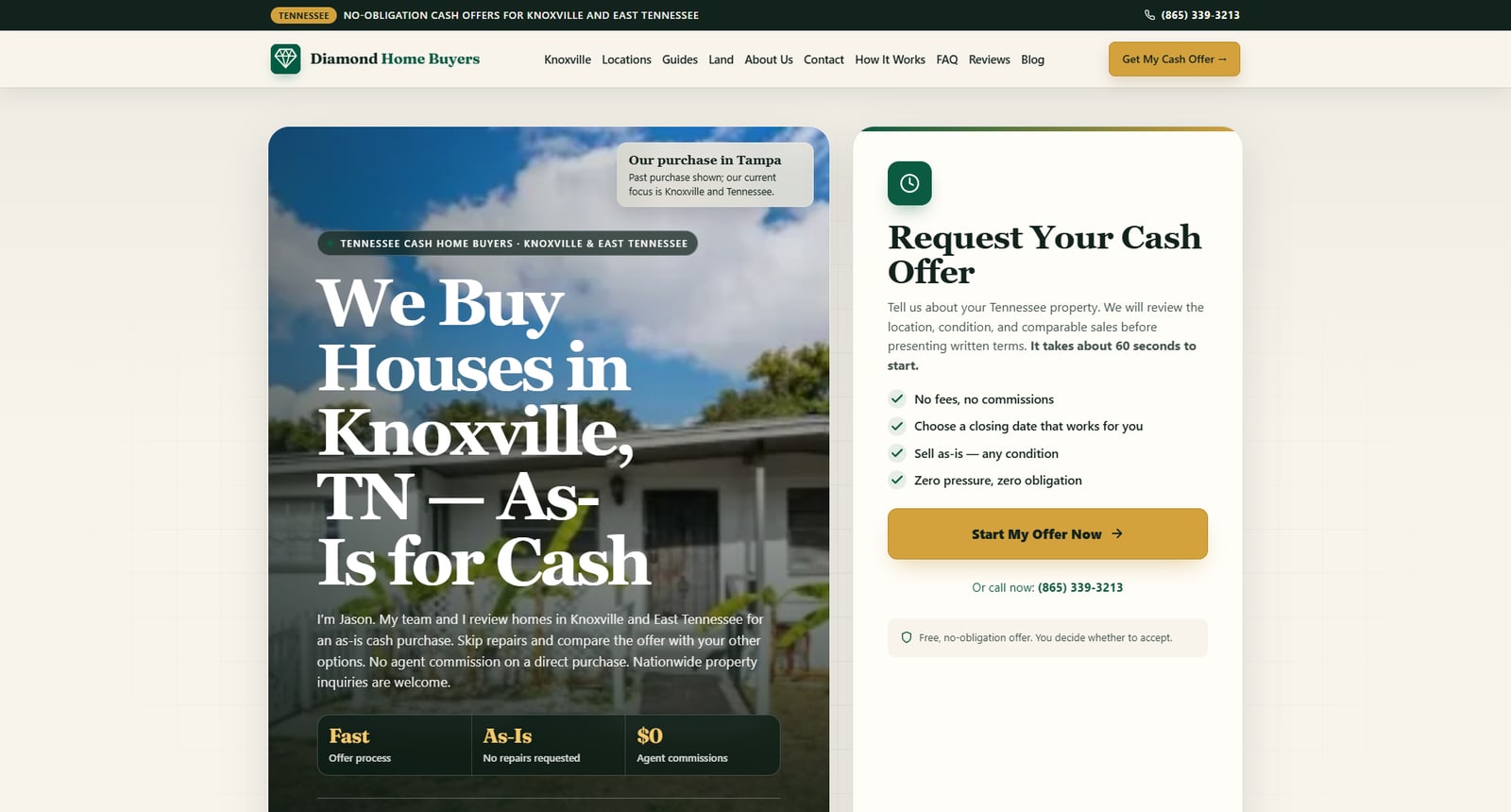
Current Diamond Home Buyers homepage captured November 10, 2026. It documents the live site appearance and is not evidence of a customer transaction or result.
Practical prep that makes a no-showing sale smoother
Even when nobody walks through, a little organization speeds things up:
Gather documents: deed, mortgage statement, tax bill, HOA details, any permits, and any prior inspection or repair records.
Take clear photos of every room, the roof, the exterior and the problem areas. Honest photos lead to more accurate offers.
Write down known issues: leaks, foundation cracks, septic trouble, code notices. You may need them for your disclosure or disclaimer.
Decide what stays. Furniture and belongings can be removed or included, depending on the agreement. Say so up front.
Set your priorities: speed, price, certainty or the least effort. Knowing which matters most lets you judge each offer.
Line up your closing help, whether that’s a title company or a Tennessee real estate attorney.
This list is useful whichever route you choose, and it’s the same information any serious buyer will ask for.
FAQ
Can I sell my house in Knoxville without any showings at all?
You may be able to avoid public showings through a direct sale or receive a sight-unseen offer, but do not assume zero access. A buyer may request a property review, inspection, appraisal, or final walk-through. Put permitted access and notice in writing.
Does selling without showings mean a lower price?
Not automatically, but cash offers for as-is houses are often lower than a fully prepared listing’s top price, since the buyer takes on repairs and risk. The better comparison is net proceeds after commissions, repairs, carrying costs and time. Get both numbers before deciding.
Do I still have to disclose problems if the buyer never sees the house?
In Tennessee, covered transfers require either a disclosure of known material defects or an as-is disclaimer, which is allowed only if the buyer waives the disclosure. Not seeing the house doesn’t remove that requirement. A Tennessee real estate attorney can tell you what applies to your sale.
How fast can a no-showing cash sale close?
There is no reliable universal closing time. A cash transaction removes buyer-loan underwriting, but title work, payoffs, probate, liens, required signers, access, and the contract still control the schedule. Treat any estimate as conditional until the closing provider confirms readiness.
How do I know a cash buyer is real?
Ask for current proof of funds appropriate to the transaction, verify the buyer’s identity and entity, read inspection and assignment terms, and use a title company or attorney for closing. Protect sensitive financial details and ask the closing provider how verification should be delivered.