
Sell a Vacant or Occupied House in Knoxville, TN
Should you move out before selling, keep living there, or skip staging and compare an as-is offer? The right answer comes from your costs, access and property condition—not an automatic rule that empty or furnished homes sell better.
Sell a Vacant House Fast in East Tennessee: Your Options

If your Knoxville or East Tennessee house is empty, compare an as-is listing, a direct cash offer, an auction and holding it. I would start with the monthly cost, property condition and your actual deadline. A direct purchase can avoid mortgage approval, but it is not automatically the fastest or highest-net option. Ask what must happen before each proposed closing date.
This guide compares your real options side by side, explains why a vacant house is a different kind of problem from an occupied one, and shows where we fit in.
TL;DR
- A vacant house costs money and risk every month: taxes, utilities, upkeep, and insurance that may limit or exclude coverage once the house has been empty for 30 to 60 days.
- A listing provides public market exposure and can also be offered as-is. Preparation, visits and financing conditions depend on the plan and contract.
- A direct as-is purchase can avoid seller repairs and a listing-agent commission. Visits and other conditions may remain; compare the actual price, net proceeds and closing terms.
- Deal with code notices, liens and unpaid taxes early. They do not go away by waiting, and some run on short deadlines.
- We consider houses and land in Knoxville, Knox County and nearby East Tennessee towns. Compare our written terms with your other options.
Table of Contents
- Why a vacant house is a different problem
- Your four main options compared
- How fast is fast?
- A simple way to decide
- Special situations with vacant houses
- Our perspective
- What to expect when you request an offer from us
- Protect the house while you decide
- FAQ
- Sources
Why a vacant house is a different problem
An occupied house looks after itself in small ways. Someone notices the leak, mows the lawn, picks up the flyers. An empty one does not, and the costs keep running while nothing comes in.
Check these issues before choosing how long to keep an East Tennessee house empty:
- Insurance gaps. Check for vacancy and unoccupancy restrictions in your own policy. According to the Insurance Information Institute’s blog, such clauses typically limit or exclude coverage after 30 to 60 consecutive days of vacancy. Call your insurer and ask exactly what your policy says, and whether a vacant-dwelling policy is available.
- Water damage. A burst pipe in a cold snap can run for weeks in a house nobody visits. That same source describes a case where a vacancy clause left the owner without coverage for repairs exceeding $60,000.
- Yard and code notices. Knox County’s code office treats an overgrown or littered lot as a violation. Its dirty lot fact sheet is marked revised February 2011 and describes notices and a ten-day re-inspection, with longer periods for large cleanups and possible extensions. Your current notice and the issuing office control the actual deadline. If the lot is not brought into compliance, the county can arrange cleanup and bill the owner.
- Break-ins and squatting. An empty house with a full mailbox signals absence to everyone on the street.
- Carrying costs. Property taxes, utilities you keep on to protect the house, lawn care and insurance continue whether or not anyone lives there.
The reasons houses sit empty also vary. Some are inherited and waiting on probate, some belong to an owner who moved for work, some are former rentals, and some were abandoned mid-renovation. Each changes which option makes sense.
Your four main options compared
There is no single best way to sell. Here is how the realistic options stack up for a vacant house in Knox County and the surrounding area.
| Traditional listing | Direct as-is cash sale | Auction or investor bidding | Keep it and wait | |
|---|---|---|---|---|
| Typical buyer | Cash or financed buyers | Local cash buyer | Investors | None yet |
| Repairs needed | As agreed; an as-is listing is possible | No seller repairs if agreed in writing | As stated in auction terms | Ongoing upkeep |
| Showings | Yes | Visits or inspections as agreed | Varies | n/a |
| Agent commission | Yes, negotiated in the listing agreement | No listing-agent commission if no separate obligation applies | Varies by sale | None |
| Price potential | Market exposure; price not guaranteed | Reflects as-is condition | Varies widely | Depends on the market later |
| Timing certainty | Depends on buyer financing, inspection and appraisal | Funds, title and written conditions control | Event date plus closing conditions | None |
| Carrying costs while you wait | Continue until closing | Stop at closing | Stop at closing | Continue indefinitely |
Option 1: List with an agent
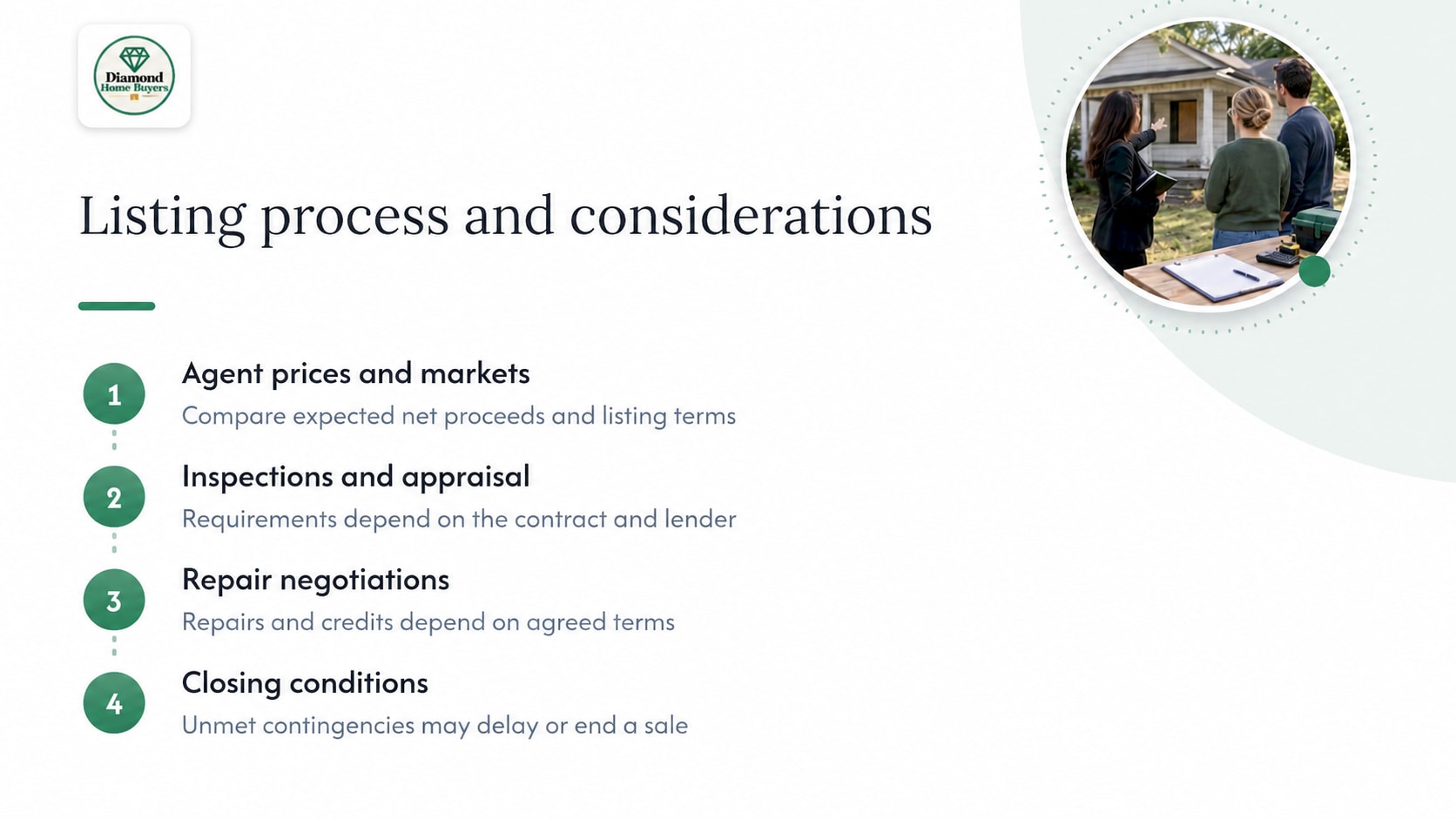
A listing is worth comparing when you want public exposure and can accommodate marketing and visits. Ask an agent for property-specific comparable sales and a realistic plan for selling as-is versus preparing the house. A house does not have to be renovated to be listed.
Empty rooms and visible wear can affect presentation, but staging is optional. Inspections, appraisals and repair negotiations depend on the contract and lender; a repair request is not automatically the seller’s obligation. Cleaning before photos may help presentation. Some owners use move-out cleaning services; that linked provider is in Celina, Texas, not a verified Knoxville service recommendation.
A sale can be delayed or end if an applicable financing, inspection or other contingency is not met. That is a contract risk to compare, not an inevitable outcome of listing or using a financed buyer. Ask how the agreement handles unresolved conditions, extensions and termination.
Option 2: Sell as-is to a cash buyer
A direct purchase may fit an owner who does not want a repair or staging project. Put any no-seller-repairs agreement in writing, identify access requirements and check whether you have a separate commission obligation. Compare the actual net proceeds with an as-is listing and a repaired sale; neither a larger headline price nor the word cash settles the choice.
That is why comparing matters. Our own Knoxville as-is cash buying page says plainly that sellers can compare a direct offer with listing and repair options, and that not every property qualifies.
A few honest cautions when you talk to any cash buyer, us included:
- Ask for the offer in writing, with price, access, costs and closing timing spelled out.
- Ask for proof of funds. A legitimate buyer can show it.
- Confirm who pays what. Closing costs, title fees and any liens payoff should be clear before you sign.
- Be cautious about anyone who asks for fees up front or pressures you to decide the same day.
- Know what the buyer is. We are a property buyer, not a law firm, tax adviser, lender or repair contractor, so for legal or tax questions you should also speak to an attorney or tax professional.
Option 3: Auction or investor bidding
Some owners try an auction-style sale or put the house in front of several investors at once. It can create competition, but timing and fees vary, and you may still carry title and closing obligations. Read every term, and compare the net amount you would receive, not the headline bid.
Option 4: Hold the house
Waiting is sometimes the right choice, for example if the house is paid off, in sound shape, and you can insure and maintain it properly. Renting it out is another path, but that makes you a landlord, with tenant selection and repairs on your plate. For many owners of empty houses, the monthly cost of holding is exactly the problem they are trying to end.
How fast is fast?
No honest buyer can promise a closing date before looking at the property and the title. Here is what actually sets the speed.
- Title. Resolve title requirements early. Liens, unpaid property taxes, unreleased old mortgages or unclear heirs add steps.
- Ownership. If the owner has died, the person with legal authority must be able to sign. Our page on selling an inherited house in Tennessee walks through the probate side.
- Access. Someone has to let the buyer in. If you live out of state, say so early, and plan how documents will be signed.
- Your own date. Many owners want a closing in a few weeks, others need a few months. Propose the date you need, then confirm whether the buyer, title work and other conditions can support it.
A financed purchase may require lender approval and an appraisal. A cash purchase avoids buyer mortgage approval but can still include inspections and other contingencies. Compare the specific steps remaining in each offer, not a promised number of days based only on the funding label.
A simple way to decide
Ask yourself these questions in order:
- Is the house move-in ready, or close to it? If yes, price a listing seriously.
- Can you afford three to six more months of taxes, utilities and insurance? If not, a direct sale gains weight.
- Does it need repairs you cannot or will not fund? A buyer taking it as-is may beat the cost of fixing it yourself. See our guide to selling a house that needs repairs in Knoxville.
- Is anything attached to the title? Liens, back taxes, code violations or a probate case can sink a listing late in the process. Disclose them up front to every buyer.
- Do you live elsewhere? Identify who can arrange visits and handle property upkeep for each route. Both a listing and a direct purchase need a practical remote-access plan.
Use our Tennessee cash offer calculator to compare estimated seller net using your own price and expense assumptions. It does not value the property or issue an offer. Test a longer holding period as well, and avoid counting the same payoff or cost twice.
Special situations with vacant houses
Behind on the mortgage
If mortgage payments are slipping, contact your servicer and qualified help promptly. The CFPB explains that a covered servicer generally cannot make the first foreclosure notice or filing until the loan is more than 120 days delinquent, subject to exceptions. Do not assume that protection applies to an empty property: these loss-mitigation provisions generally concern a borrower’s principal residence. Vacancy alone does not decide principal-residence status; the facts and applicable law matter. Application timing and eligibility matter. The CFPB also discusses selling your home as one possible option. A purchase contract alone does not stop a foreclosure.
Obtain a current payoff and estimate all closing expenses. If proceeds are insufficient, other funds or creditor approval may be needed; a short sale requires lender approval. A HUD-approved housing counselor can help you explore mortgage options. Our Tennessee foreclosure timeline gives process context, but a Tennessee attorney should review any sale notice and deadline. We are a property buyer, not a foreclosure-rescue service.
Inherited and probate houses
Heirs often end up with an empty house they never planned for. Before anyone can sell, it must be clear who has authority to sign. A probate attorney can confirm that. Once authority is settled, a direct sale can end the monthly drain of an estate property.
Back taxes and liens
The Knox County Trustee provides local tax-sale information. Confirm your parcel’s current balance and case stage with the responsible office and obtain legal advice if a sale is pending. The closing professional must identify how taxes and other liens will be resolved; do not assume the sale price automatically clears them.
Code violations on an empty lot or house
Respond to the issuing office and use the deadline on the actual notice. The dirty lot handout is a 2011 publication, not proof that every current case has the same ten-day deadline. This guide to selling a vacant house in Knoxville also retains occupied-versus-vacant, access and property-record guidance below.
Mobile homes and land
If what you have is a mobile home on land, or just a vacant lot or acreage, the process differs, because access, utilities, survey and septic questions drive value. We cover Tennessee land and acreage and mobile homes with land separately.
Our perspective
Diamond Home Buyers is a local company serving Knoxville and surrounding East Tennessee. A vacant property might be an inherited house, a former rental or a home left after a move. I would rather understand that situation and the actual property condition than treat every empty building as the same kind of deal.
Preparation gives the closing team better information. Gather the deed, current loan information, tax records, notices and access arrangements before comparing offers. These records do not guarantee a quick closing, but they help identify questions that need an attorney, insurer, servicer or title professional.
A direct purchase is not the best choice for every house. Compare the proposed price and responsibilities with a realistic listing plan. Any as-is terms, costs, access and closing conditions belong in the agreement. Ask a buyer to substantiate its funding and explain any assignment or cancellation rights before signing.
What to expect when you request an offer from us
We consider houses, rentals, inherited properties, mobile homes with land and vacant land, with Knoxville and Knox County first, and Maryville, Alcoa, Oak Ridge, Sevierville, Lenoir City and nearby East Tennessee after that. The steps are simple:
- You tell us about the property: address, condition, ownership, and what you hope to achieve.
- We review the property, ownership, condition and closing requirements.
- If it qualifies, you receive a written, no-obligation offer.
- You compare it to listing and other options, at your own pace.
- If you accept, closing details are agreed in writing and a title company handles the paperwork.
If you want to see what a direct sale of your empty house might look like, start on our Tennessee as-is cash offer page or read our FAQ for property sellers.
Protect the house while you decide
Whichever route you take, a few steps keep an empty house from getting worse:
- Call your insurer today and ask about vacancy limits.
- Keep the lawn cut and the mailbox cleared, so the house does not draw a code complaint.
- Know where your main water shutoff is, and consider winterizing or having someone check the house during freezes.
- Have a neighbor, relative or property manager visit on a schedule.
- Gather your deed, mortgage statement, tax bill and any notices in one folder.
Occupied or vacant: what changes for a seller?
Before moving out for a sale, compare two actual schedules. If you stay, which days can you accommodate visits, where will pets go, and what personal belongings need to be secured? If you move, who will check the house and how will you pay for both properties? Furniture can show a room’s purpose, but appointment disruption and privacy are real costs too.
Vacancy can simplify visit scheduling without improving the house itself. Photograph its current condition and list the work you actually plan to do. Get the insurer’s occupancy requirements and a property-care plan before canceling utilities or moving the last belongings. Do not treat an empty room as a repaired room or a second housing payment as a free expense.
Separate occupancy from presentation
A lived-in home can be staged. An empty home can be poorly presented. Decide whether the specific improvement is worth its cost before paying to move out.
Does staging mean a 1–5% higher offer?
Not as a promise. In the 2025 Profile of Home Staging report, 17% of buyers’ agents reported offers 1–5% higher for staged homes than similar unstaged homes. That is an agent survey, not evidence that every staged house earns that increase or that vacant homes beat occupied ones.
NAR’s consumer guide on staging explains presentation choices. Ask a Knoxville listing agent what comparable buyers notice in your price range. Avoid treating a national percentage as extra money already earned.
What will staging and waiting actually cost?
The NAR survey reported a $1,500 median for a staging service and $500 when the seller’s agent personally staged the home. The $500 figure is not a virtual-staging price. These are historical national survey figures, not a Knoxville quote.
- Light preparation: use the furniture you already have, remove clutter and make rooms easier to walk through.
- Professional staging: get a written scope, delivery charge, rental term, extension cost and removal date.
- Virtual staging: ask how edited photos will be labeled and keep the real condition visible. Digital furniture must not disguise damage.
Freddie Mac’s staging guidance discusses decluttering and presentation. Start with affordable steps, not a renovation budget built around a promised price increase.
Add mortgage payments, taxes, insurance, utilities, yard care, property checks and travel to the budget. If you move first, include the second housing payment. Estimate each selling path with the same likely time period and a delay allowance. For current county tax-payment resources, use the Knox County Trustee’s official payment resources.
What if tenants still live in the property?
Tenant-occupied is different from owner-occupied. Collect the lease, amendments, payment history, deposit records and any written notices. Have the buyer and a Tennessee attorney confirm how the sale affects the tenancy before promising move-out or possession.
Nolo’s guide to selling with tenants gives general background. The source article also references landlord entry rules from Wisconsin’s Tenant Resource Center; those Wisconsin rules are not a Tennessee notice schedule. Do not apply a generic 24–48-hour rule to every Knoxville showing. Check your lease and applicable Tennessee requirements with qualified local advice.
Agree on access respectfully and in writing. Do not assume listing a house ends a lease or permits entry whenever convenient. If rent or condition issues complicate the decision, compare selling a rental with bad tenants with a sale that keeps the tenancy in place.
Arrange a Property Visit When You Cannot Be There
If you live outside Knoxville, prepare a short visit brief before anyone goes to the house. The goal is simple: the right person gets access, knows what can be checked, and leaves the property secure. Confirm that you have authority to arrange entry; an apparently empty house is not proof that nobody has occupancy rights.
- Name the visitor and agree on a time window. Confirm the person, company, purpose of the visit, and a number you can call independently. Identify a local contact if someone needs to meet them.
- Describe conditions before arrival. Note which utilities are on, known damage, locked rooms, pets, and any areas that must not be entered. Do not ask someone to enter an unsafe building or turn on a disconnected system just to complete a walkthrough.
- Share access details privately. Send key or lockbox instructions only to the authorized visitor. Keep codes out of public listings, social posts, and shared property photos.
- Set the scope. Agree whether the visit includes photos, measurements, or a contractor's evaluation. Permission to look is not permission to remove belongings, start repairs, or invite other people.
- Close the loop afterward. Ask for confirmation that the visitor has left and doors are secured. Request dated observations and a list of anything they could not check. Change temporary access arrangements when they are no longer needed.
Keep unknowns visible
For each major system, record three things: what was observed, what could not be tested, and who will follow up. A heating system that was off during the visit should be marked “not tested,” not “working.” A walkthrough is not a substitute for an appropriate professional inspection.
When Diamond Home Buyers arranges a visit, confirm who is attending and what they will evaluate with your point of contact. See how our property review and offer process works and our seller questions and answers. An appointment is not a commitment to sell or a guarantee of an offer.
Check the Address, Jurisdiction, and Open Records
“Knoxville” in a mailing address does not always mean the property is inside Knoxville city limits. Confirm the governing jurisdiction before relying on a city checklist or calling the wrong office. For property inside the city, the City of Knoxville Neighborhood Codes Enforcement page explains how the city handles reports involving unsecured vacant buildings, dilapidated structures, overgrown lots, dumping, and other neighborhood-code concerns.
The city says owners are responsible for securing vacant houses, including windows, doors, and other openings. Before marketing the property, walk the exterior, photograph current conditions, record who has keys, and check for notices attached to the structure or mailed to the owner. Do not assume that fixing the most visible issue closes an existing case.
| Record to check | Why it matters before an offer | Useful starting point |
|---|---|---|
| Code complaint or open case | May identify an inspection, correction deadline, cleanup, or hearing that should be disclosed and assigned in the contract. | Knoxville Neighborhood Codes Enforcement for city property |
| Permit and inspection history | Can reveal unfinished or unapproved work that affects buyer diligence, repair scope, or closing conditions. | City of Knoxville record search |
| City and county property taxes | Current balances affect the seller’s net proceeds and may need to be collected or paid through closing. | City tax search and Knox County Trustee |
| Recorded liens and ownership | A code record is not a substitute for a title search; recorded claims and signer issues can delay closing. | Title company, Tennessee closing attorney, and Knox County land records |
The City’s Codes & Requests page lists research options including permit history, inspection results, and outstanding violations. Ask for current written information tied to the exact parcel and case number. If the property is outside the city, contact the applicable Knox County office or municipality instead.
Do not use a different Knoxville’s rules
Search results can mix Knoxville, Tennessee with Knoxville, Iowa. Confirm that every government page uses an official Tennessee or Knox County domain before relying on a form, fee, or deadline.
Vacant-House Closing Checklist
- Confirm every owner and authorized signer.
- Order title work early and identify mortgages, taxes, judgments, estate issues, or contractor liens.
- Use a reputable Tennessee title company or closing attorney.
- Give accurate access instructions and do not hide known hazards.
- State in the contract which contents, vehicles, appliances, or materials stay.
- Keep insurance and agreed utilities active through the required date.
- Verify wiring instructions independently before sending money or sensitive documents.
- Arrange key transfer, final access, and any post-closing occupancy in writing.
Our buyer-verification checklist and cash-offer guide can help you compare offers without relying on a headline price alone.
Compare an offer before deciding to move or stage
Share the address, condition and occupancy. We will review the property and discuss whether an offer fits. No obligation to accept.
You can request a cash offer or call (865) 339-3213.
Compare occupied and vacant sale terms
Compare the move date, access and property expenses alongside the price. An as-is sale can be considered before committing to staging; it does not eliminate title or contract conditions. Explore your cash-sale option
FAQ
Can I sell a house fast in East Tennessee if it is empty?
An empty house can be sold, but it is not automatically a faster sale. Timing depends on ownership authority, access, title, funds and the written conditions. Ask the buyer and closing professional what remains unresolved before relying on a date.
Do I have to make repairs before selling a vacant house?
An agreed as-is purchase can avoid seller repairs. An as-is listing is also possible. Inspections, lender requirements and repair negotiations depend on the transaction; a request does not automatically require you to pay. Compare the written terms.
Will insurance cover a vacant house?
It depends on your policy. Many standard policies limit or exclude coverage after 30 to 60 days of vacancy, so ask your insurer directly and consider a vacant-dwelling policy if you will hold the house for long.
What if I owe more on the house than it is worth?
A sale generally needs to cover the payoff and closing costs. If it does not, talk to your mortgage servicer and a HUD-approved housing counselor about alternatives before you sign anything.
Do you also buy vacant land in East Tennessee?
Yes, we consider vacant lots, rural acreage and inherited land, subject to review of title, access, utilities and septic questions. See our land page for details.
Is it better to sell a house occupied or vacant?
Neither is automatically better. Compare presentation, showing access, moving expenses, insurance and monthly holding costs. Staging survey results do not prove that moving out will increase your sale price.
Does staging guarantee a higher offer?
No. National survey results describe agents’ reported experiences, not a guaranteed return for your Knoxville property. Get a written local quote and compare the full net proceeds of each option.
Can I sell a Knoxville rental with tenants still living there?
Discuss the lease, occupancy rights, access arrangements and deposit records with your agent, buyer and a Tennessee attorney. Do not promise vacant possession or an entry schedule without checking the agreement and applicable requirements.
Sources
- When No One’s Home: Understanding the Role of Vacancy Insurance, Triple-I
- Knox County Code Administration, Dirty Lot Fact Sheet
- How to avoid foreclosure, Consumer Financial Protection Bureau
- Avoid foreclosure options, Consumer Financial Protection Bureau
- Tax Sale, Knox County Trustee
- Consumer guide: Staging your house for a sale — NAR
- Tips for selling a property with existing tenants — Nolo
Recommended
- Sell a Vacant House Fast in Knoxville TN
- Sell My House Fast Tennessee | As-Is Cash Offers
- Sell My House Fast Tennessee | As-Is Cash Offers
- We Buy Houses East Tennessee | Cash Home Buyers
- How to Sell a Vacant House Fast (and Stop the Drain)
- How to Sell a Rental House With Bad Tenants
- Sell a Rental Property With Tenants in Knoxville TN
- What Does Selling a House “As-Is” Really Mean?
General education, not legal, tax or insurance advice. For mortgage-servicing scope and exceptions, see CFPB scope rules and loss-mitigation requirements. Get advice for the actual property and deadline.