

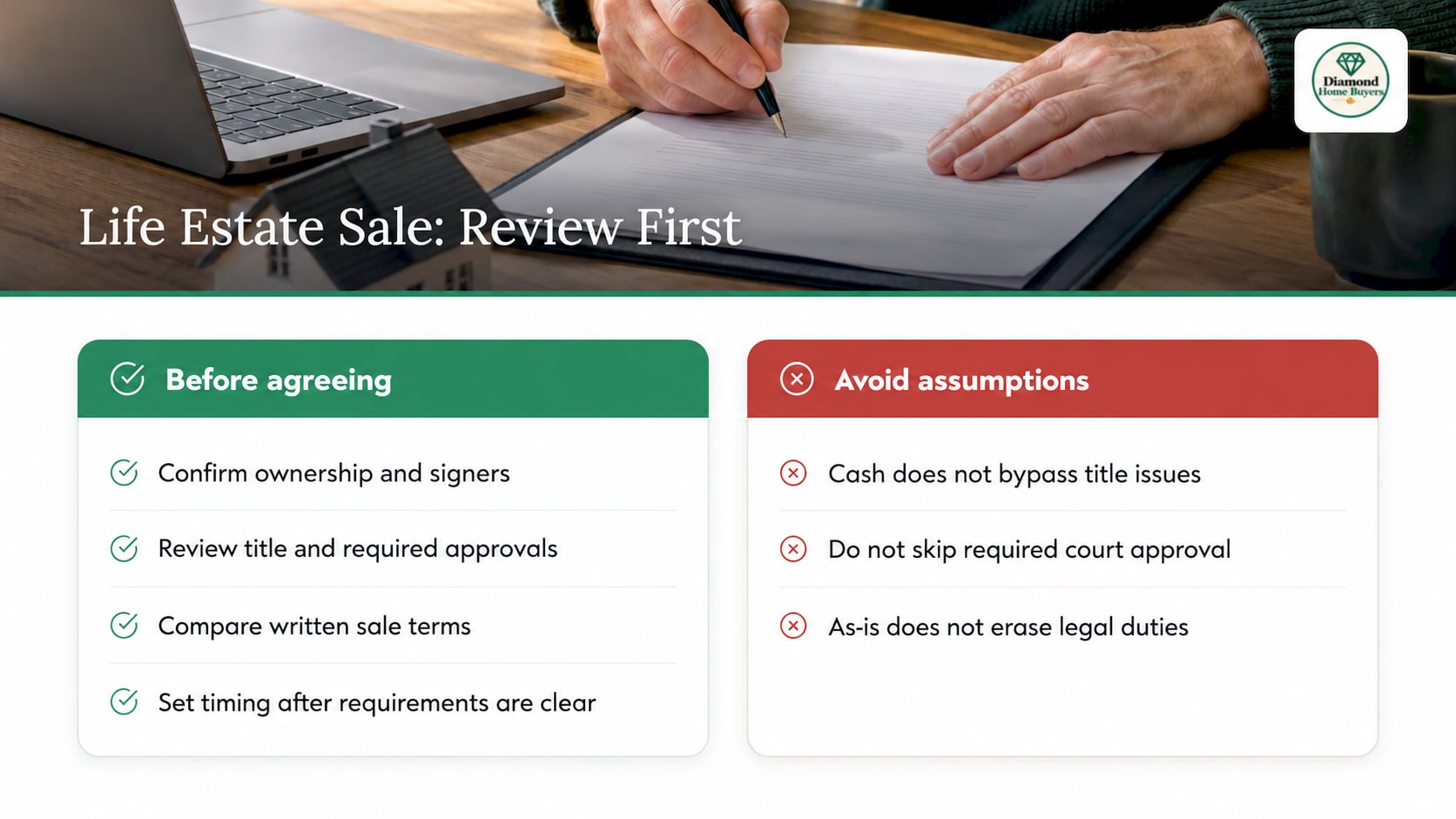
You can sell an interest in a Tennessee house with a life estate, but first establish exactly what you own. Selling the whole property is different from selling only the right to use it during a lifetime. I would start with the deed and a title review, not a promised closing date. Cash does not let a buyer skip required signatures, title work or a court order.
This guide separates the ownership question from the price question. A joint sale, a voluntary release and a court proceeding are different routes with different requirements. This is general information, not legal, tax or benefits advice. Have a Tennessee real-estate attorney and the closing professional review your documents before signing a deed or sale contract.
In this guide
- What rights does a life tenant have, and what does the remainder owner own
- Can you sell a home if it has a life estate?
- Legal methods to sell or clear title
- How Tennessee taxes a retained life estate at the recordation stage
- Probate, court involvement and timing
- Practical steps checklist for sellers and heirs
- What families actually do when they need to sell a life estate property
- Selling a Tennessee life estate property to Diamond Home Buyers
- FAQ
- Sources
Who owns which part of a life-estate property?
A life estate generally gives one person a present right to possess and use property for the life identified in the creating document. A remainder interest is a future interest that becomes possessory when the life estate ends, subject to that document and applicable law. A remainder can already be vested even though the holder cannot yet take possession. “Future possession” and “no ownership until death” are not the same thing.
Read the actual deed, will or trust. Who is the measuring life? Are there several remainder owners? Are there conditions, reserved powers, restrictions or later deeds? Is the person speaking with the buyer an owner, an agent under a power of attorney, or a relative trying to help? Those answers change who can sign and what can be sold.
Possession does not automatically mean authority to sell everyone else's rights. Nor does holding the remainder automatically permit evicting the life tenant. Questions about rent, taxes, insurance, repairs or damage to the property deserve advice based on the instrument. Do not assume that one family member can settle them for everybody.
Can you sell the whole house or only your interest?
- A life interest alone: a seller cannot convey more rights than they hold. A buyer of that interest generally takes the limited interest, not an unrestricted right lasting beyond the relevant life.
- A remainder interest alone: a transfer generally remains subject to the existing life estate. The new remainder owner does not automatically receive immediate possession.
- The whole property: the required interest holders may be able to join in a deed that conveys their combined interests. A separate release before sale is not the only possible consensual route.
Price comparisons need to match the rights offered. A fee-simple comparable sale is not automatically the value of a limited life interest or remainder. Obtain appropriate valuation advice, and ask the closing professional to describe the interest the proposed deed would actually transfer. Do that before agreeing how sale proceeds will be divided.
Which sale or release route fits?
Joint conveyance. When everyone who must sign has authority and agrees, counsel can consider a deed signed by the necessary holders. The closing file still needs title requirements, liens, identity and any applicable approvals resolved. Agreement among relatives is useful, but an informal family text is not a substitute for the required instruments.
Voluntary release. A life tenant may be able to release their interest to the remainder holder. Confirm the effect on housing rights, taxes and any benefits before signing. A release may be difficult to reverse. Do not treat it as a harmless administrative step or the cheapest route in every case.
Retaining a life estate in a new deed. A person who owns the relevant full interest may convey a remainder while reserving a life estate. A person who owns only a life estate does not thereby acquire someone else's remainder to convey. The chain of title matters more than the label on a form.
Court involvement. Tenn. Code § 29-27-208 addresses sale of a life estate with the remainder. Subsection (a) refers to the life tenant's assent. Subsection (b) concerns a person under disability or unknown and a court determination after considering the circumstances. It is not a universal rule allowing a dissatisfied remainder owner to force an immediate sale over an objecting, capable life tenant. Subsection (c) also addresses how the life interest may be valued or proceeds invested. Ask an attorney what procedure is actually available.
If a required signer cannot act, examine existing authority and whether a conservatorship or another court step is necessary. A buyer, relative or title employee cannot simply sign for that person because a sale seems sensible. Build the timeline around the answer, not around an advertised cash-closing deadline.
How does Tennessee transfer tax apply?

The Tennessee Department of Revenue's state guidance on calculating recordation tax concerns a warranty deed that includes a retained life estate. It describes using the property's fair market value less the calculated life-estate value. It offers two valuation alternatives; it does not say that IRS tables are the only permitted approach. If the IRS actuarial method is used, the applicable rate and valuation assumptions must be checked for the transaction.
The supplied Recordation Tax Manual is a dated manual, so confirm the current instructions rather than using an old table without review. Ask the deed preparer to identify the instrument, calculation method and any claimed exemption in the closing file.
Revenue guidance REC-17 states that a transfer due to release of a life estate is exempt from transfer tax under the cited statute. That does not establish that every related sale, recording charge, income-tax consequence or benefits consequence disappears. Have the actual transfer classified before estimating your net proceeds.
Does a life-estate sale require probate?
Not automatically. During the life estate, identify the existing interests and authority to transfer them. After the measuring life ends, the remainder ordinarily becomes possessory under the governing instrument; it is not accurate to say it always first “vests” at death. The closing professional may need death evidence and other title documents.
Probate may matter if an estate owns an interest or estate administration affects the transaction. A deed defect, disagreement or missing person may instead require a different legal process. The guide to selling during probate in Tennessee addresses estate administration, not a rule that every life-estate property must pass through probate.
Ask for a written list of unresolved items: missing signatures, uncertain ownership, mortgage payoffs, court authority, valuation or document recording. Get an estimate for each from the person responsible. Neither a cash offer nor a cooperative family guarantees how quickly a court, creditor or title underwriter will finish its work.
What should you gather before requesting an offer?
- Collect the recorded deed and documents creating or changing the life estate. Include relevant trust, probate or authority papers, if any.
- List the named interest holders and known changes, such as a death or a later transfer. Let counsel determine who must participate.
- Gather mortgage statements, tax notices, insurance information and known lien or judgment records.
- Describe occupancy and condition. Is the life tenant living there? Is there a tenant? Who can authorize access?
- Ask an attorney and closing professional which transaction routes are available before ordering unnecessary documents.
- Compare an appraisal or broker's market analysis of the relevant interest with actual written offers and estimated transaction costs.
- Document how proceeds, moving arrangements and possession would be handled before anyone signs.
Our piece on quitclaim deeds in Tennessee explains why a deed's name does not settle title or authority questions. Do not use a blank quitclaim form to “fix” the life estate without advice. An outside estate property allocation guide discusses estate-property allocation in another jurisdiction; it is background reading, not Tennessee law or a substitute for a local valuation or legal review.
How can a family compare its options?
Keep the questions separate. First, can the required parties convey the interest a buyer wants? Second, does selling make financial and practical sense? Third, what arrangements protect the person currently entitled to occupy the home? Answering only the price question can leave a family with a contract it cannot perform.
For example, if the life tenant wants to remain in the house, a sale requiring vacant possession may not meet that person's needs. If all necessary holders want a full sale, ask counsel about a joint conveyance rather than assuming a court case is inevitable. These are decision examples, not stories about completed Diamond transactions.
I would compare the expected net proceeds, the time required to satisfy title conditions, any repair spending, and the risk of a failed closing. If agreement is missing, obtain legal advice before spending money based on a sale date. Record each person's position without assuming it amounts to a binding release or consent.
Can Diamond Home Buyers review the property?
Yes. Share the property location, condition, occupancy and the documents you have. I or my underwriting team reviews properties we consider buying, with a clear point of contact. We can discuss an as-is offer, but we cannot promise to purchase every property or bypass an unresolved ownership issue.

We also consider Tennessee land as-is for cash. For either a house or land, ask who would purchase, whether partners or an assignment are involved, which conditions remain, and what the written agreement says about costs and possession. Our standard closing-cost coverage does not mean we automatically pay every seller debt, legal bill or tax obligation beyond the agreed terms.
Request a cash offer when you are ready to compare options. A direct sale may reduce repair and marketing work but can produce a lower price than a successful listing. Set a closing date only after the necessary title and authority requirements are understood. A faster buyer does not make a missing legal right appear.
Frequently asked questions
Can you sell a Tennessee home with a life estate?
An interest may be transferable, but a life tenant alone cannot convey more rights than they hold. A full sale may involve a joint deed by all required holders, a valid release or an applicable court process. Have the creating documents and title reviewed first.
How is transfer tax calculated when a deed retains a life estate?
Tennessee Revenue REC-4 addresses a warranty deed retaining a life estate and describes valuation alternatives. A separate release may qualify for the exemption discussed in REC-17. Ask the deed preparer which treatment applies; it is not a universal exemption from all taxes or charges.
Can a life estate be ended early?
A voluntary release may be possible, but it affects real ownership and occupancy rights. If a signer cannot act or parties disagree, obtain legal advice about available procedures. A disagreement alone is not permission for a buyer to bypass a life tenant.
Does a life-estate property always need probate?
No. A remainder may become possessory under the governing instrument when the life estate ends. Probate or another proceeding depends on ownership and the actual legal issues, not simply the presence of life-estate language.
Sources and scope
- REC-4 - Calculating Realty Transfer Tax on Warranty Deed including Retained Life Estate – Tennessee Department of Revenue — guidance for the specified deed type, with alternative valuation methods.
- Realty Transfer Recordation Tax (Recordation Tax Manual) – Tennessee Department of Revenue — dated source manual; verify current guidance for the transaction.
- TN Code § 29-27-208 - Sale of life estate (Partition) – Justia — statute text; obtain advice on the applicable procedure and facts.